

Latent Accumulation Risk
Australia, China and the Hidden Dependencies Within Insurance Portfolios
Executive Insight
Key question
Where are insurers carrying China-linked dependency without recognising it as accumulation risk?
Key insight
Some of the most material insurance exposures may no longer arise from individual suppliers, isolated events or single insureds. They may arise from the quiet build-up of connected dependencies across clients, industries, supply chains, infrastructure, fuel systems, critical minerals and end markets.
Why it matters
Australia’s relationship with China is no longer a peripheral trade exposure. It is a structural feature of the Australian economy.
In 2025, two-way goods and services trade between Australia and China was valued at approximately A$326 billion, representing 25% of Australia’s total goods and services trade. Australian exports to China totalled approximately A$196 billion, representing 29% of Australia’s global goods and services exports.
For insurers, that scale matters.
The issue is not whether China should be treated as a simple risk factor. That would be too blunt. The more important question is whether China-linked dependency has become so commercially normal, profitable and embedded that accumulation is no longer being clearly seen.
Executive Summary
Australia’s economic relationship with China has delivered significant benefits over the past two decades. It has supported export growth, infrastructure development, investment, lower-cost inputs, manufacturing capability and access to one of the world’s largest consumer markets.
For insurers, those same dynamics have supported growth across commercial, construction, marine, agriculture, trade credit, infrastructure and liability portfolios.
But the nature of the exposure has changed.
Historically, insurer concerns regarding China were often focused on visible underwriting issues: product quality, manufacturing standards, regulatory oversight, supply chain transparency, contract enforceability and rights of recourse.
Those issues still matter.
However, the more material exposure may now sit beneath the surface. It may sit in the connected dependencies that link insured clients to common suppliers, processing capability, logistics networks, customer markets, critical minerals, fuel systems, technology platforms and infrastructure corridors.
This paper argues that insurers may be increasingly exposed to hidden concentrations across these systems without fully recognising the extent of that dependency until disruption occurs.
Solaris refers to this phenomenon as:
Latent Accumulation Risk
The accumulation of interconnected dependencies that appear manageable in isolation but become material when disrupted together.
The implications extend beyond traditional political risk. Latent accumulation risk may influence underwriting performance, business interruption outcomes, contingent business interruption exposure, product recall, marine and logistics claims, trade credit deterioration, claims inflation, capital allocation and portfolio resilience.
The challenge for insurers is not simply to identify exposure to China.
It is to understand where China-linked dependency accumulates across the portfolio, how those dependencies connect, and how quickly they could transmit stress if external conditions change.
Executive Insights
1. Australia’s exposure to China is material, concentrated and commercially normalised
China is not a marginal trading partner for Australia. It is embedded in export markets, imported goods, manufacturing inputs, critical minerals processing, infrastructure, logistics, technology and investment flows.
That scale creates opportunity. It has supported growth, efficiency and access to global markets.
But it also means dependency can become harder to see. When a relationship is commercially productive and deeply embedded, it is less likely to be treated as an accumulation exposure2. Many insurance portfolios cannot easily see where this concentration accumulates
Traditional accumulation analysis focuses on geography, industry or insured values.
Emerging exposures increasingly accumulate through systems.
2. Many insurance portfolios may not clearly show where dependency accumulates
Traditional accumulation analysis often focuses on geography, natural catastrophe zones, insured values, industries or individual counterparties.
Those views remain important.
But they may not reveal system dependency.
A portfolio can appear diversified by insured, industry and location while still carrying common exposure to the same supplier base, customer market, transport route, critical input, technology platform, fuel system or processing capability.
That is where latent accumulation risk can build.
3. Future losses may originate from dependency rather than direct physical damage
A material loss does not always begin with damage to an insured asset.
It may begin with a restricted input, a delayed shipment, an unavailable component, a trade restriction, a fuel disruption, a cyber event affecting logistics, a customer-market shock or a sudden increase in replacement cost.
The original trigger may sit outside the insured location.
The financial impact may still move through business interruption, contingent business interruption, marine, trade credit, product recall, liability, cyber, construction delay, claims inflation or portfolio volatility.
4. The key challenge is exposure visibility before disruption
China-linked exposure should not be treated as inherently adverse. Quite the opposite.
It remains one of Australia’s most commercially significant relationships and, for many insureds, a source of scale, growth, supply chain efficiency and market stability.
The insurance issue is not China exposure itself.
The issue is unmanaged concentration.
At approximately 25% of Australia’s total goods and services trade, the relationship is large enough that insurers should be able to identify where dependency is diversified, where it is concentrated, and where it may be accumulating unnoticed across clients, classes and claims pathways.
The Solaris Thesis
Insurance portfolios are traditionally assessed through visible and classifiable exposures: insured locations, declared activities, values at risk, peril zones, industry segments, policy limits and known aggregation points.
Those measures remain necessary, but they are increasingly incomplete.
A portfolio can appear diversified across insureds, industries and geographies while still carrying a high degree of dependency on the same external systems. The concentration may not be visible in the insured asset, the occupation code, the policy schedule or the loss history. It may sit deeper in the operating model: shared suppliers, processing capacity, logistics corridors, export markets, fuel availability, replacement parts, technology platforms or critical inputs.
This is the Solaris thesis.
Latent accumulation risk emerges when dependencies that appear ordinary at account level become correlated at portfolio level.
The individual risk may be technically acceptable. The client may be well managed. The policy may be within appetite. The pricing may appear adequate based on historic performance.
But if multiple insureds rely on the same external assumptions, the portfolio may be carrying a concentration that has not been expressly identified, priced or governed.
The issue is not dependency itself. Modern economies depend on specialisation, trade, scale and efficient supply chains.
The issue is unmanaged dependency: where repeated reliance on the same systems creates correlation across risks that otherwise appear unrelated.
For insurers, the practical implication is significant. Accumulation management cannot be limited to physical proximity, catastrophe exposure or large-limit monitoring. It must also consider dependency pathways that can transmit loss through business interruption, contingent business interruption, claims inflation, product recall, marine delay, trade credit deterioration, construction delay, cyber disruption or liability exposure.
Latent accumulation risk is therefore not an abstract emerging risk concept.
It is a portfolio visibility problem.
And the central question is whether insurers can identify where normalised commercial dependency has become correlated insurance exposure before disruption reveals it through claims experience.
Australia and China provide the case study.
The Shift From Risk Quality to System Dependency
Historically, China-related underwriting concerns were often assessed at the transaction or supplier level.
The focus was practical and familiar: product quality, manufacturing standards, counterfeit goods, regulatory oversight, contract enforceability, rights of recourse and recovery prospects following loss.
Those concerns remain relevant. They continue to matter for product liability, product recall, construction defects, procurement controls, claims recovery and supplier due diligence.
However, they no longer describe the full exposure.
The material change is not simply that China is a large manufacturing jurisdiction. It is the degree to which China now sits across multiple systems that Australian insureds rely on: trade flows, manufacturing inputs, processing capacity, energy transition materials, machinery, electronics, renewable energy components, pharmaceuticals, replacement parts, infrastructure, customer markets and policy settings.
The scale is material.
China’s manufacturing value-added was reported at approximately US$4.66 trillion in 2023, representing around 28% of global manufacturing value-added. For Australia, two-way goods and services trade with China was approximately A$326 billion in 2025, representing 25% of Australia’s total goods and services trade. Australian exports to China were approximately A$196 billion, representing 29% of Australia’s global goods and services exports.
These figures do not support a conclusion that China-linked exposure should be avoided.
They support a more technical conclusion: the relationship is large enough, productive enough and embedded enough that insurers should understand where dependency is diversified, where it is concentrated and where it is accumulating across portfolios.
This is where the underwriting question changes.
The issue is no longer only whether an individual supplier is reliable, whether a product meets specification, or whether contractual recourse is available after a loss.
The more relevant question is how many insureds, across different portfolios and classes of business, rely on the same external systems continuing to function.
That may include the same customer market, the same manufacturing base, the same port infrastructure, the same shipping corridor, the same fuel assumptions, the same critical mineral inputs, the same replacement-part supply, or the same tariff and trade settings.
Critical minerals provide a useful example. The International Energy Agency reported that the average market share of the top three refining nations for key energy minerals rose from around 82% in 2020 to 86% in 2024, with around 90% of supply growth coming from the top single supplier alone for several minerals. That is not merely a resource issue. It is an input dependency issue for renewable energy, batteries, grid infrastructure, electronics, transport, advanced manufacturing and replacement equipment.
Fuel security provides another indicator of system dependency. DCCEEW reported that, at normal consumption rates, March quarter 2026 industry-held MSO stocks were equivalent to 37 days of petrol, 30 days of jet fuel and 32 days of diesel. Fuel availability sits behind transport, logistics, agriculture, construction, emergency response, mining, retail distribution and claims fulfilment. A portfolio does not need to be written as an energy portfolio to be exposed to fuel disruption.
Trade routes also matter because disruption does not need to occur in Australia or China to affect Australian insureds. Export Finance Australia reported that Red Sea rerouting around the Cape of Good Hope increased journey times by 30–50% and raised sea freight and insurance costs. For insurers, that type of disruption can move through marine, cargo, construction delay, business interruption, contingent business interruption, stock availability, repair lead times and claims inflation.
Tariffs and trade restrictions show the policy dimension of the same problem. The US Studies Centre notes that China’s 2020 restrictions on Australian exports affected wine, barley, beef, timber, coal, cotton and lobsters, with some affected exports to China falling to nearly zero. The insurance issue is not only whether a policy directly responds to a tariff. It is whether altered market access changes revenue, receivables, substitution costs, stock movement, supplier behaviour, product quality or customer demand.
This is the shift from risk quality to system dependency.
Risk quality asks whether the individual account is acceptable.
System dependency asks whether the operating assumptions behind that account are resilient, substitutable and diversified, and whether the same assumptions are repeated elsewhere in the portfolio.
An individual insured may present well. The supplier may be reputable. The product may meet specification. The policy may sit within appetite. The premium may appear adequate. The claims history may be clean.
But if multiple insureds rely on the same input source, trade route, processing capacity, customer market, fuel assumption, tariff setting or replacement-part supply, the insurer may be carrying an accumulation that is not visible through individual account assessment.
The concern is not poor underwriting of individual risks.
The concern is that technically sound underwriting decisions can still create portfolio-level concentration when common dependencies are not identified and aggregated.
As China's role within global manufacturing, processing, infrastructure and technology systems has expanded, many of the most material insurance exposures have shifted from individual transactions to interconnected systems.
The question is no longer simply:
"Is this supplier reliable?"
Increasingly, the more important question is:
"How many insureds depend on the same supplier, processor, infrastructure system, logistics corridor or market?"
The focus has shifted from assessing risk quality to assessing system quality.
This shift sits at the centre of Solaris' Latent Accumulation Risk framework.
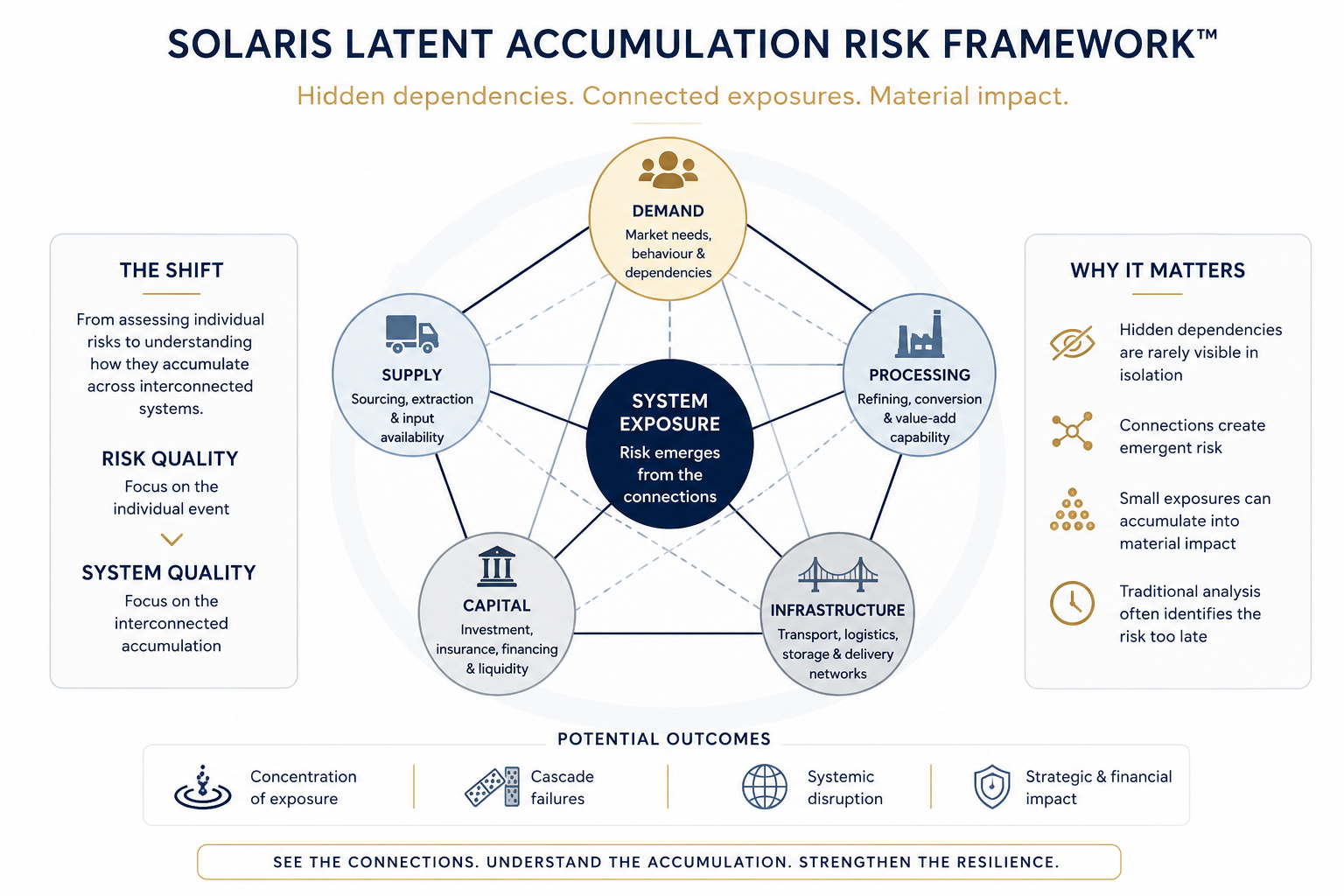
Introducing the Solaris Latent Accumulation Risk Framework™
Traditional accumulation analysis remains essential, particularly for natural catastrophe exposure, geographic concentration, large property schedules, industry segments and policy-limit aggregation.
However, those methods are primarily designed to identify visible concentration.
Latent accumulation risk requires a broader diagnostic lens.
It focuses on co-dependency rather than co-location.
The framework asks:
Where do multiple insureds rely on the same external systems, and what happens if those systems are disrupted?
Solaris identifies five primary accumulation pathways.
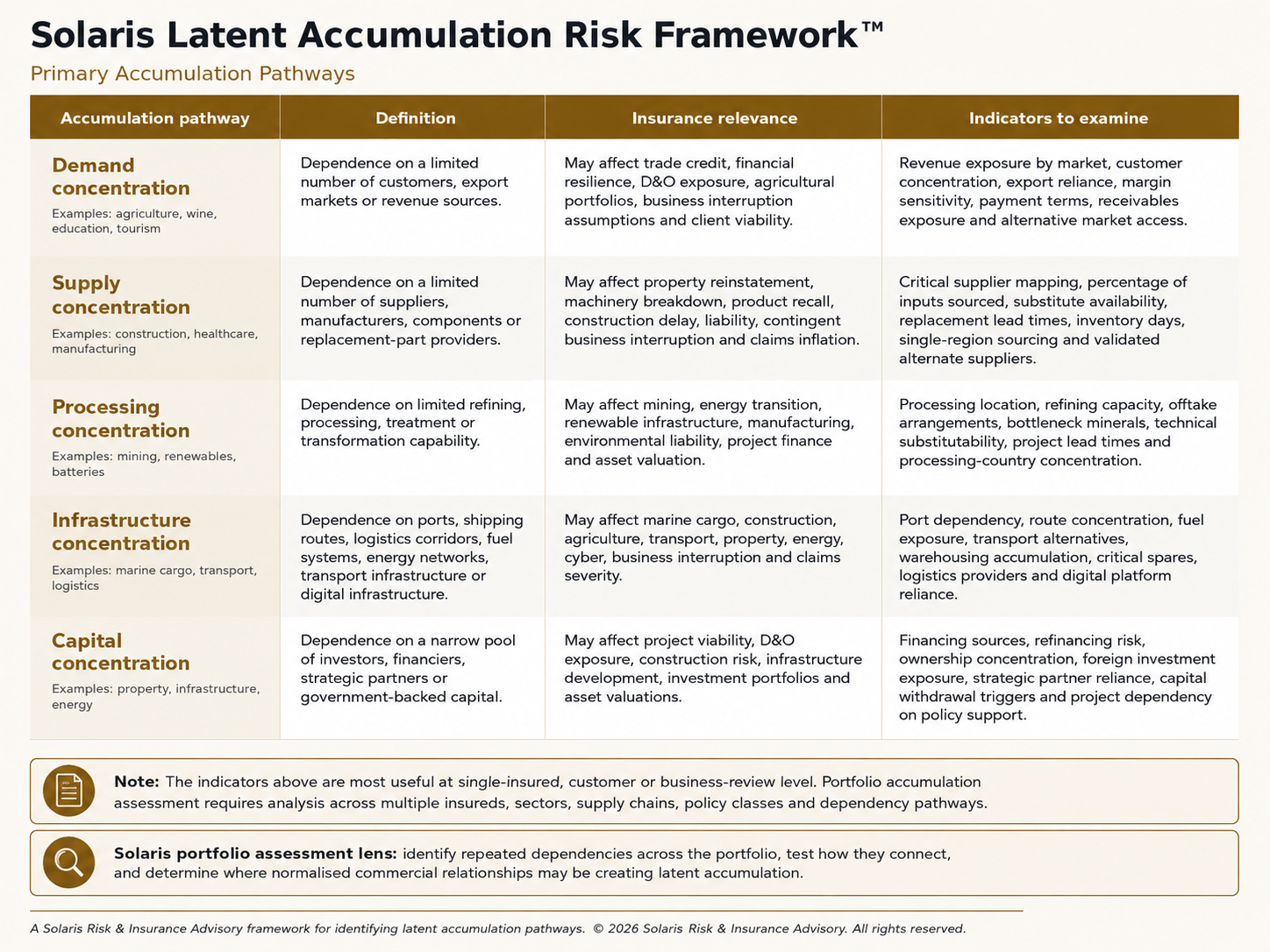
Why this matters for insurers
Latent accumulation risk matters because it can cause portfolios that appear diversified at account level to behave as though they are concentrated under stress.
The issue is not only whether an insured is exposed to a particular supplier, customer, trade route or market. The issue is whether similar dependencies are repeated across multiple insureds, sectors and policy classes.
This has several insurance implications.
First, losses may emerge across more than one class at the same time. A disruption that begins as a supply-chain issue may affect business interruption, contingent business interruption, marine cargo, product recall, construction delay, trade credit, liability, cyber and claims inflation.
Second, accumulation may sit outside the usual categories used to monitor portfolio exposure. Geography, occupation, ANZSIC code, insured value and policy limit remain important, but they may not reveal shared dependency on the same input, processor, customer market, port, logistics corridor, technology platform or financing source.
Third, historical loss experience may understate the exposure. If the underlying dependency has not been stressed, prior performance may reflect favourable operating conditions rather than true resilience.
Fourth, the policy response may be difficult to assess until the disruption occurs. Multiple policies may be affected by the same external event, but respond differently depending on trigger, wording, causation, exclusions, waiting periods, sub-limits and proof of loss.
For insurers, this creates a practical challenge.
A single insured may present as acceptable. A portfolio of similar dependencies may not.
That is why latent accumulation risk should be treated as a portfolio management issue, not only an emerging risk theme.
Why Insurers Miss It
Latent accumulation risk is not usually missed because insurers lack expertise. It is more often missed because the relevant signals are fragmented across the insurance value chain and are not consistently assembled into a portfolio view.
Supplier dependency may be visible in the underwriting file → customer-market exposure may be understood by the broker → limited substitution options may be identified through risk engineering → longer repair or replacement timeframes may emerge through claims → sector-level margin pressure may be observed through portfolio review → claims inflation may appear in actuarial analysis without the underlying dependency pathway being fully visible.
None of these signals is necessarily weak on its own.
The weakness lies in the failure to connect them.
When these observations remain separated by function, product class or data system, the insurer may see individual risk features without recognising the accumulation forming across the portfolio.
Several common failure modes are relevant.
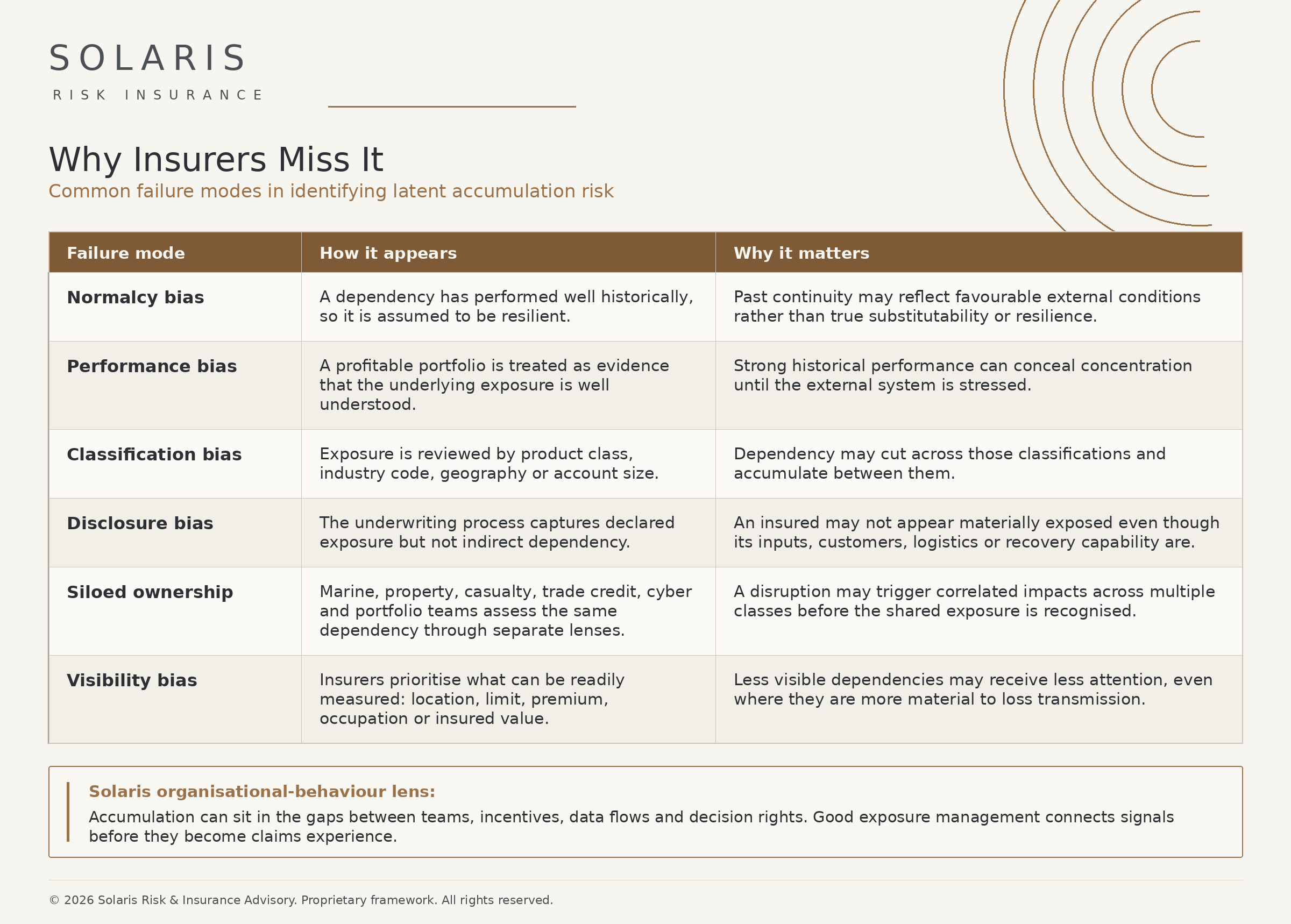
What Leaders Should Watch
The pathways identify where latent accumulation may form.
The next question is what signals indicate that those dependencies are beginning to move from normal operating exposure into active portfolio risk.
For insurers, the objective is not to predict a single geopolitical outcome. It is to identify when stable commercial assumptions are beginning to weaken across multiple insureds, sectors or policy classes.
Useful early-warning signals include:
| Signal | What to watch | Why it matters |
|---|---|---|
| Lead-time movement | Increasing delivery times for machinery, electronics, construction materials, vehicles, medical equipment, renewable components or specialist parts. | Extended lead times can increase reinstatement periods, prolong business interruption losses and amplify claims severity even where the original loss event is ordinary. |
| Replacement-cost movement | Sharp changes in repair costs, imported materials, freight costs, equipment pricing or availability of substitute parts. | Claims inflation may be an early sign that external dependency is affecting portfolio performance before it appears as a defined accumulation issue. |
| Supplier substitution failure | Clients reporting that alternative suppliers exist in theory but cannot meet quality, scale, certification, timing or price requirements. | This distinguishes genuine resilience from assumed resilience and is highly relevant to BI, CBI, product liability and recovery assumptions. |
| Revenue concentration stress | Falling demand, delayed payments, cancelled orders or increased receivables pressure in China-exposed customer markets. | Dependency may transmit through revenue and cash flow rather than physical damage, affecting trade credit, client viability and D&O exposure. |
| Logistics friction | Route disruption, port congestion, freight-rate spikes, container shortages, rerouting, war-risk pricing or marine insurance cost movement. | Logistics stress can connect otherwise separate insureds through shared transport routes, cargo accumulation, construction delay, stock availability and claims fulfilment. |
| Policy response uncertainty | Increasing reliance on supplier and customer extensions, denial or prevention of access provisions, delay clauses, contingent BI wording or trade credit triggers. | Ambiguity in policy response can become more material when several insureds are exposed to the same external disruption. |
| Cross-class claims movement | Similar stress appearing across property, marine, casualty, trade credit, cyber, construction or product recall portfolios. | This may indicate that the issue is not class-specific but dependency-driven. |
| Governance trigger events | Tariff changes, export controls, sanctions, fuel-security pressure, critical mineral restrictions, port disruption or abrupt policy shifts. | These events can change the operating assumptions behind multiple insureds at the same time. |
© 2026 Solaris Risk & Insurance Advisory. Proprietary framework. All rights reserved.
The value of these indicators is not in any single signal.
Their value lies in pattern recognition.
A longer lead time may be manageable. A freight-rate increase may be absorbed. A customer payment delay may appear account-specific. But when similar signals begin appearing across multiple insureds, sectors and policy classes, the insurer may be seeing the early movement of latent accumulation into active exposure.
The leadership task is to identify those patterns before they are expressed through claims experience.
What Good Accumulation Management Looks Like
Managing latent accumulation risk does not require insurers to avoid complex or valuable markets.
It requires better exposure discipline.
The practical task is to move from account-level confidence to portfolio-level visibility: identifying where dependencies repeat, how they connect, which policy classes may respond, and whether the insurer is intentionally accepting the correlated exposure.
This requires action across five areas.
1. Portfolio Strategy
Insurers should map dependency concentrations, not only geographic concentrations.
Traditional portfolio reviews often focus on geography, industry sector, premium volume, large limits, loss ratio movement and catastrophe exposure. Those remain important, but they do not show whether multiple insureds rely on the same external systems.
A stronger portfolio review should test for repeated dependency across:
customer markets
supplier regions
processing capacity
logistics routes
ports and shipping corridors
critical inputs
fuel assumptions
technology platforms
replacement-part supply
financing sources
The output should be a dependency heat map that shows where exposures repeat across insureds, sectors and policy classes.
2. Decision Quality
Insurers should challenge assumptions of diversification and resilience.
A portfolio may appear diversified because insureds operate in different industries or locations. That does not mean the underlying dependencies are diversified.
Decision quality improves when insurers ask:
Are we relying on claims history as evidence of resilience?
Are alternative suppliers genuinely available, or only theoretically available?
How long would substitution take under stressed conditions?
Which assumptions are embedded in BI and CBI exposure estimates?
Are we pricing individual risks while retaining portfolio-level correlation?
What would change our view of the exposure?
This is not only an underwriting issue. It is a decision-governance issue.
3. Emerging Risk Monitoring
Insurers should convert monitoring into action triggers.
Tracking geopolitical, supply chain or macroeconomic indicators has limited value unless those indicators are linked to portfolio decisions.
Useful triggers may include:
materially longer lead times for replacement parts
freight-rate or war-risk pricing movement
trade credit deterioration
fuel-security pressure
export controls or tariff changes
port disruption
critical mineral restrictions
supplier insolvency
cross-class claims movement
increasing reliance on policy extensions or sub-limits
The aim is not to predict the next disruption. It is to identify when stable operating assumptions are changing and when underwriting, pricing, appetite or governance settings should be reviewed.
4. Governance
Latent accumulation risk should be visible at executive and board level where it is material to appetite, capital, reinsurance or strategy.
This does not require every dependency to become a board issue.
It does require a clear escalation pathway where dependency concentration may affect portfolio resilience, earnings volatility, claims severity, reinsurance assumptions or capital adequacy.
Good governance should define:
who owns dependency exposure data
how dependency concentrations are reported
what thresholds trigger review
which committees receive escalation
how underwriting appetite is adjusted
how claims and actuarial signals feed back into portfolio decisions
This aligns with broader risk-management expectations that material risks should be identified, measured, monitored, reported and supported by exposure aggregation, risk measures and forward-looking scenario analysis. APRA’s CPS 220 requires risk-management frameworks to include forward-looking scenario analysis and stress testing based on severe but plausible assumptions, supported by data capable of aggregating exposures and risk measures across business lines.
5. Investment and Capital Strategy
Insurers should consider whether capital allocation strengthens resilience or deepens concentration.
This applies both to underwriting portfolios and broader strategic choices.
Growth into attractive sectors may be commercially sound, but if those sectors share the same external dependency, the insurer may be increasing correlated exposure while appearing to diversify.
Capital, reinsurance and portfolio strategy should therefore consider:
whether growth portfolios share common dependency pathways
whether reinsurance structures respond as expected under dependency-driven scenarios
whether capital models adequately reflect non-catastrophe accumulation
whether risk appetite distinguishes between diversified growth and concentrated growth
whether exposure is being intentionally retained or unintentionally accumulated
The strongest response is not avoidance.
It is informed selection.
Insurers should be able to say where the dependency sits, how it connects, what would activate it, which policies may respond, how the portfolio would be affected, and whether the return justifies the accumulation being carried.
The purpose is not to predict the next disruption.
The purpose is to understand where dependency has accumulated before disruption occurs.
Board and Portfolio Questions
Latent accumulation risk becomes more manageable when it is translated into the right questions.
For boards, executives and portfolio leaders, the issue is not whether every dependency can be eliminated. In most cases, it cannot and should not be.
The issue is whether material dependencies are visible, understood and governed before they become claims experience.
The following questions may assist insurers in testing whether normalised commercial dependency has become portfolio-level accumulation.
| Area of review | Key questions |
|---|---|
| Exposure visibility | Do we know which insureds have material dependency on China-linked suppliers, customers, inputs, logistics, processing capability, technology platforms or replacement parts? Is this information captured consistently, or does it sit informally across underwriting files, broker knowledge, claims observations and risk engineering reports? |
| Portfolio concentration | Are we aggregating dependency across insureds, industries, policy classes and claims pathways? Could a portfolio that appears diversified by geography, occupation or class still be exposed to the same external systems? |
| Business interruption and CBI | Do our BI and contingent BI assumptions reflect realistic substitution times, replacement lead times, supply-chain depth and customer-market dependency? Are sub-limits, waiting periods and extensions aligned with the exposure being written? |
| Claims inflation and recovery time | Are delays in parts, equipment, materials, labour or imported inputs already affecting claims severity or settlement duration? Are these being treated as isolated claims issues or as indicators of wider dependency pressure? |
| Client resilience | Are insureds able to evidence alternative suppliers, inventory buffers, logistics options, critical spares, customer diversification and continuity planning? Are we distinguishing between stated resilience and validated resilience? |
| Pricing and appetite | Where dependency is concentrated, are we being adequately paid for the correlated exposure? Are appetite settings, deductibles, limits, conditions and underwriting referrals reflecting dependency risk, or only traditional risk quality? |
| Cross-class impact | Could the same external disruption affect more than one class at the same time, including property, marine, trade credit, cyber, casualty, product recall, construction delay, BI or CBI? Who owns that cross-class view? |
| Governance and triggers | What indicators would prompt review of appetite, pricing, claims assumptions or portfolio exposure? Are changes in trade restrictions, fuel security, shipping routes, critical minerals, export demand, supplier lead times or claims inflation feeding into portfolio governance? |
| Data and accountability | Who is accountable for connecting dependency signals across underwriting, claims, actuarial, risk engineering, portfolio management and executive risk? Is dependency data structured enough to support decision-making, or is it still largely narrative? |
The strongest question is not simply:
“Are we exposed?”
Most insurers are.
The better question is:
“Where are we carrying repeated dependencies that appear acceptable at account level but may behave as correlated exposure at portfolio level?”
That is where latent accumulation risk becomes a governance issue, not just an underwriting observation.
Solaris Insight
The most significant exposures are not always the most visible. In increasingly interconnected environments, competitive advantage may come from recognising the connections others overlook.
Many of the dependencies discussed in this paper are not new.
Australia's economic relationship with China has developed over decades. Trade, supply chains, fuel security, critical minerals, infrastructure and investment have long been part of that story.
What appears to be changing is the extent to which these systems are becoming interconnected.
Individually, many of these exposures appear manageable.
Collectively, they may create concentrations that are difficult to recognise until disruption occurs.
The challenge for insurers is not simply understanding individual risks.
It is understanding where those risks accumulate.
The most significant risks are not always the ones we can see.
They're often found in the connections between them.
The Solaris Lens
This paper forms part of Solaris' ongoing work exploring:
Portfolio Strategy
Decision Quality
Emerging Risk
Risk Governance
Through the lens of interconnected exposure and latent accumulation.
Confidential – Solaris Risk & Insurance Advisory. Proprietary methodology. Not for distribution or reproduction without written consent.
© 2026 Solaris Risk & Insurance Advisory. All rights reserved.
