

Softening Markets, Hardening Risk
Portfolio Volatility, Aggregation and the Emerging Insurance Cycle
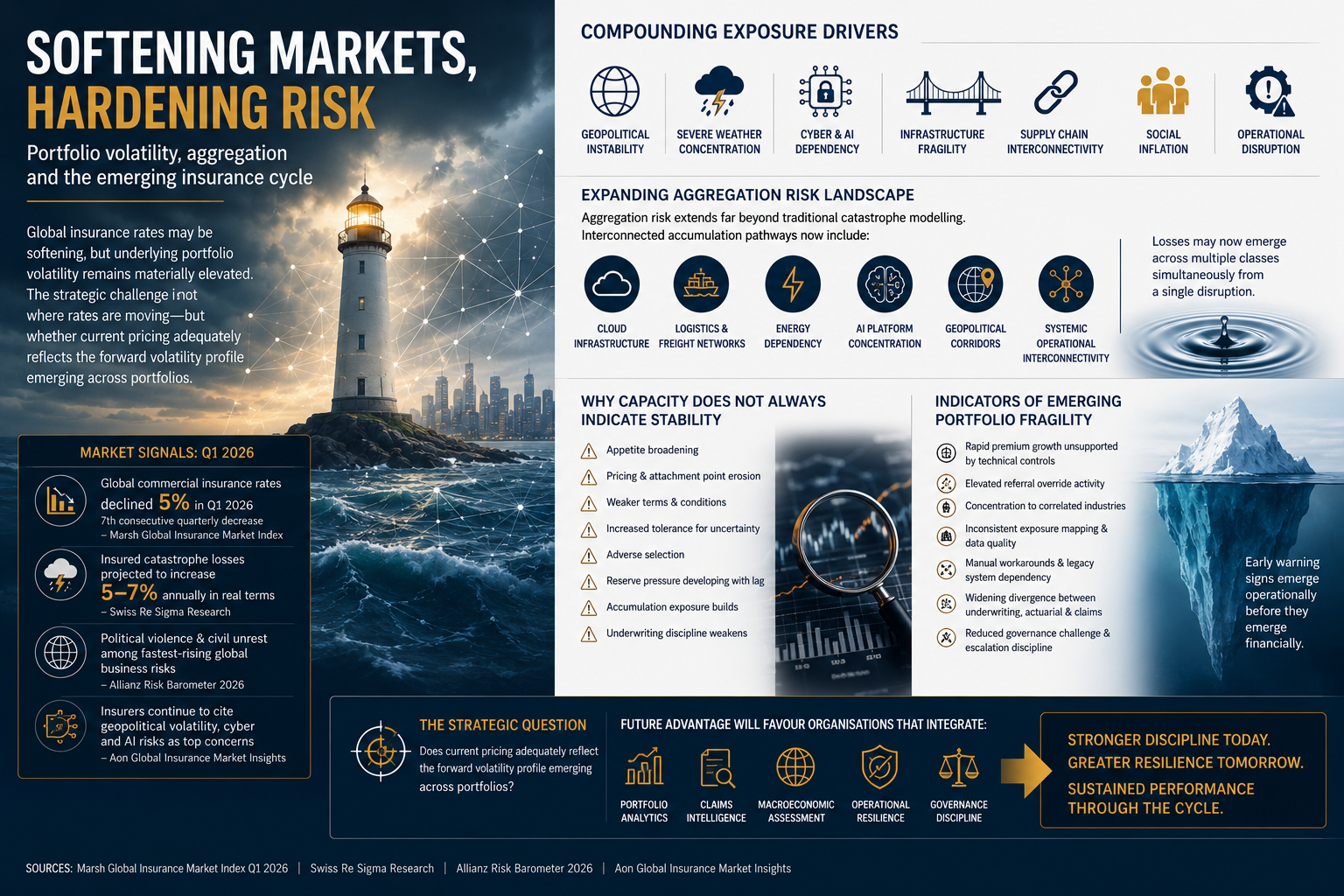
Over the past several decades, insurance markets have repeatedly demonstrated that pricing cycles and underlying exposure quality do not always move in alignment.
Periods of sustained pricing competition have historically coincided with a gradual erosion of underwriting discipline, increasing tolerance for uncertainty and a build-up of exposure that only becomes visible once loss experience begins to develop. The lag between risk accumulation and financial recognition has been a consistent feature of prior market cycles.
The current environment presents a similar tension.
According to Marsh, global commercial insurance rates declined by 5% in Q1 2026, marking the seventh consecutive quarterly reduction. Capacity has improved across several classes and competitive pressure is beginning to re-emerge.
At face value, this is often interpreted as a sign of market stabilisation.
However, the underlying exposure environment remains materially more complex and volatile than pricing conditions alone would imply.
Swiss Re continues to project catastrophe losses increasing at approximately 5–7% annually in real terms, driven by rising insured values, economic inflation and increasing concentration of exposure. At the same time, Allianz has identified political violence and civil unrest among the fastest-rising global risks, while Aon continues to highlight insurer concern around geopolitical instability, cyber exposure and systemic disruption.
Taken together, these conditions point to a widening gap between pricing signals and the actual risk environment.
“Softening rating conditions do not necessarily indicate improving underlying portfolio resilience.”
The Expanding Complexity of Modern Portfolio Risk
The composition of insurance risk is changing in ways that are not fully reflected in traditional portfolio views.
Historically, aggregation has been understood primarily through geography. Exposure accumulated where risks were physically concentrated, and catastrophe modelling evolved to quantify the financial impact of events occurring within defined locations. While this remains relevant, it is no longer sufficient.
Aggregation risk is increasingly driven by shared systems and interdependencies rather than shared location.
Many insureds now rely on the same underlying infrastructure — cloud platforms, energy supply, logistics networks, telecommunications and data services. These dependencies create common points of failure across portfolios that may appear diversified on the surface but are, in practice, connected.
As a result, a single disruption can trigger losses across multiple lines simultaneously. A cyber event affecting a major cloud provider, an energy supply shock, or a failure within a critical logistics network can generate claims across property, business interruption, liability and specialty classes at the same time.
These are not isolated events. They are systemic in nature.
This shifts aggregation from something that is visible and modelled to something that is embedded and often only partially understood. Correlation is no longer driven solely by physical proximity. It is driven by operational dependence.
Traditional catastrophe frameworks were not designed to capture this level of interconnectivity. As a consequence, accumulation exposure may be building in areas that sit outside conventional monitoring and reporting structures.
For insurers, this presents a structural challenge.
Portfolio diversification can no longer be assumed based on geography, industry class or product segmentation alone. It requires a more detailed understanding of how risks are connected through the systems they depend on.
Without that visibility, portfolios that appear well balanced may, in reality, carry concentrated exposure to a small number of shared failure points.
Aggregation is no longer confined to catastrophe.
It sits across the portfolio.
Capacity, Competition and the Risk of Mispricing
“Periods of increasing market capacity can create the appearance of stabilisation even while underlying volatility continues compounding beneath the surface”
Periods of increasing capacity have historically been interpreted as a signal of improving market conditions. More capital, greater competition and broader underwriting appetite are often associated with stability and confidence.
In practice, they can also signal the early stages of pricing dislocation.
As capacity returns, competitive pressure begins to influence underwriting behaviour. Pricing discipline is tested, terms and conditions are negotiated more aggressively and a greater volume of risk is written at thinner margins. The shift is rarely abrupt. It develops incrementally, often supported by recent profitability and benign loss experience.
The difficulty is that many of the underlying drivers of loss do not move in step with pricing.
Catastrophe exposure continues to grow as asset values increase and development concentrates risk. Social inflation continues to influence liability outcomes. Cyber exposure expands alongside digital dependency. Geopolitical instability introduces additional uncertainty across supply chains, energy markets and operational continuity.
These forces are not immediately reflected in premium levels. They emerge over time, often with a lag that can extend across multiple underwriting years.
This creates a structural risk within the cycle.
Premium adequacy can deteriorate while reported performance remains strong. Loss ratios may appear stable, supported by prior year releases or the absence of major events, even as exposure quality weakens beneath the surface. In this environment, premium growth can obscure underlying deterioration in risk-adjusted return.
The effect is most pronounced in classes where loss development is longer-tailed or less predictable. Casualty, professional lines, construction and cyber portfolios are particularly exposed to this dynamic. Pricing decisions made in the current environment may not be fully tested until several years later.
The market is therefore balancing two competing forces.
On one hand, there is pressure to deploy capacity — to maintain premium volume, defend distribution position and support return on capital. On the other, there is the requirement to preserve underwriting integrity in the face of increasing uncertainty.
How insurers navigate this balance will determine the resilience of their portfolios as the cycle develops.
Periods of softer pricing do not remove risk from the system.
They change how it is priced.
Indicators of Emerging Portfolio Fragility
“Problems in a portfolio usually show up operationally before they show up in the numbers.”
Deterioration in a portfolio does not typically appear first through headline financial results.
More often, it develops incrementally through changes in underwriting behaviour, operational strain and a gradual loss of alignment between risk selection, pricing and portfolio oversight. These signals tend to emerge well before loss ratios or reserve positions begin to reflect them.
One of the clearest indicators is a shift in underwriting discipline. This may not be explicit. It often emerges through a steady increase in referral overrides, a greater willingness to write outside stated appetite or a reliance on judgement in areas where pricing confidence is limited. Over time, these decisions accumulate and reshape the portfolio in ways that are not immediately visible.
Premium growth patterns can provide early warning, particularly where growth is concentrated in sectors exposed to the same underlying drivers. Rapid premium expansion, particularly in sectors exposed to the same underlying drivers, can introduce concentration that is not fully recognised. Where this growth is not supported by corresponding improvements in data quality, exposure mapping or technical oversight, the portfolio becomes increasingly sensitive to common shocks.
Operational indicators are equally important. Rising dependence on manual processes, delays in data capture, inconsistencies in classification or a growing gap between reported exposures and actual risk can all signal weakening portfolio visibility. These issues are often treated as operational constraints that directly affect underwriting quality and portfolio visibility, but in practice they directly affect underwriting quality and the ability to respond to emerging risk.
A further indicator is divergence across core functions. Where underwriting, actuarial and claims perspectives begin to move out of alignment, it becomes more difficult to form a coherent view of portfolio performance. Claims teams may observe changes in frequency or severity that are not yet reflected in pricing. Actuarial assumptions may rely on historical experience that no longer reflects current exposure. Underwriting decisions may continue to be made within parameters that are no longer appropriate.
In these conditions, performance can appear stable even as underlying risk quality deteriorates.
The absence of immediate loss activity or reserve movement should not be interpreted as confirmation of portfolio strength. It may instead reflect the lag between risk selection and loss emergence.
Portfolios under strain tend to exhibit a combination of these characteristics. Individually, they may appear manageable. Collectively, they indicate a system that is becoming less responsive, less aligned and more exposed to future volatility.
Changes in underwriting behaviour and operational strain typically precede any movement in loss ratios or reserves.
The Emerging Strategic Divide
The current market is not simply softening. It is fragmenting.
Pricing is beginning to ease, but the underlying exposure environment remains structurally more volatile than in prior soft market phases. Catastrophe losses continue to trend upward in real terms, geopolitical instability is increasing, and systemic dependencies across infrastructure, energy and technology are introducing new forms of correlation that are not fully captured in traditional underwriting frameworks.
This creates a more complex version of a familiar cycle dynamic.
In previous cycles, softening conditions were often driven by excess capacity following periods of strong profitability. Underwriting discipline weakened gradually as competition increased, and the consequences were realised through reserve deterioration and adverse loss development over time.
The difference now is that exposure complexity has increased at the same time that pricing discipline is being tested.
Correlation is no longer primarily geographic. It is systemic. A single disruption can now generate losses across multiple classes simultaneously through shared dependencies. This increases the likelihood that portfolio stress emerges faster and with less warning than in prior cycles.
At the same time, many portfolios are being managed with frameworks and assumptions developed under less complex conditions.
This introduces a structural mismatch.
Pricing decisions are increasingly being made in an environment where:
forward loss behaviour is more uncertain,
aggregation pathways are less visible,
and traditional indicators of diversification may no longer hold.
Against this backdrop, insurer responses are beginning to diverge.
Some are allowing competitive pressure to influence underwriting behaviour. Growth targets, broker expectations and market positioning are driving decisions at the margin. In these portfolios, appetite expands incrementally, pricing becomes more reactive and exposure accumulates in areas where visibility is limited.
Others are responding by tightening alignment between exposure, pricing and capital. Underwriting decisions are anchored in forward risk conditions rather than recent performance, and there is a greater willingness to accept reduced premium growth or market share in the short term where pricing confidence is not sufficient.
This divergence will not be immediately visible in reported results.
Short-term performance may remain stable across both groups, supported by prior underwriting years and the absence of major loss events. However, the underlying trajectory of the portfolios is materially different.
The key point is this:
The next phase of the cycle is unlikely to be defined solely by pricing.
It will be defined by how well portfolios have been constructed to withstand a more complex and interconnected risk environment.
In that context, the distinction between competitiveness and discipline becomes more consequential.
Portfolios that have expanded under competitive pressure without a corresponding increase in visibility and control are more exposed to sudden correlation-driven loss events and delayed reserve adjustment.
Portfolios that have maintained alignment between underwriting, pricing and exposure — even at the expense of short-term growth — are more likely to absorb volatility without structural deterioration.
The market will ultimately reprice.
The question is which portfolios will require it most.
Increasingly, strategic advantage may favour organisations capable of integrating:
portfolio analytics,
claims intelligence,
macroeconomic assessment,
operational resilience,
aggregation visibility,
and governance discipline
into earlier underwriting, appetite and capital allocation decisions with real time monitoring being the ideal.
This may require greater willingness to:
tolerate periods of short-term uncompetitiveness,
preserve underwriting discipline,
maintain technical pricing integrity,
and resist broadening appetite beyond operational visibility and pricing confidence.
The central strategic issue for the market may no longer simply be:
“Where are rates moving?”
But rather:
“Does current pricing adequately reflect the forward volatility profile now emerging across portfolios?”
That is a materially different underwriting and capital management conversation.
Conclusion
The current cycle is developing under materially different conditions to previous soft market phases.
Global commercial insurance rates declined 5% in Q1 2026, marking the seventh consecutive quarter of rate reductions, according to Marsh. At the same time, catastrophe losses continue to trend upward, with Swiss Re estimating insured losses have exceeded USD 100 billion for six consecutive years and are increasing at approximately 5–7% annually in real terms.
What is changing is not simply pricing, but the structure of risk.
Exposure is more interconnected, aggregation is less visible and correlation is increasingly driven by shared systems and dependencies rather than geography alone. Geopolitical instability, cyber exposure and operational interconnectivity are introducing loss pathways that are less predictable and less well captured by traditional underwriting frameworks.
At the same time, the financial impact of current underwriting decisions will emerge with lag.
Loss development, reserve adequacy and the effect of pricing decisions made today will not be fully visible for several underwriting years. In that period, portfolios can continue to report stable performance even as exposure quality deteriorates and accumulation risk builds.
This is where the current phase of the cycle becomes critical.
The next phase will be defined by how portfolios have been constructed relative to the risk they have been priced for — how well aggregation is understood, how discipline has been maintained and how closely underwriting decisions reflect forward risk conditions rather than recent experience.
The market will continue to soften until loss experience, capital pressure or volatility forces repricing. On current indicators, that point cannot be far away.
When that adjustment occurs, pricing will respond.
For insurers, the issue is not the adjustment itself, but the position carried into it.
Portfolios written under competitive pressure, without sufficient visibility over aggregation, correlation and forward loss behaviour, are more exposed to adverse development and reserve strengthening before pricing can respond.
By contrast, portfolios constructed with discipline — where pricing reflects uncertainty, exposure is understood and underwriting decisions remain aligned to risk — are better positioned to absorb volatility and benefit from the repricing phase.
The distinction is not whether the market corrects.
It is which portfolios require correction, and which are positioned to take advantage of it.
Sources
